note: this is an edit and amalgamation of a previous, deleted article
Harry Potter has been the focus of a lot of Christian authors and laymen, since those branded fundamentalists have warned people to avoid the book series, now a franchise, and many have made fun of those people, generating significant attention and arousing passions. The anti-Potter sentiment has even been spoken by popular exorcist and priest Chad Ripperger, who has claimed that the exorcist consensus is to avoid this literature. While I have zero information about such a consensus, and I take no joy in making fun of people who are fearful or concerned for the well-being of others, I want to consider the potential pitfalls of consuming media with lots of magic usage.
This actually matters
I want to establish briefly that this actually does matter, since literature subtly influences us. Advertisers and social media companies know this better than anyone. Since we spend over a quarter of our waking hours consuming media, these companies work diligently to see that you have an opinion a product or political viewpoint, and now everybody knows that ’the algorithm,’ though it might not change your mind in an instant, is able to subtly manipulate you in ways imperceptable to many (or if they notice, they scroll anyways, so it doesn’t matter). Whether intentional or not, this same concept applies to literature.
Problem solving with magic
A most common theme I see throughout most magical fiction (I’m thinking modern fiction) is that every problem quickly manifests the proverb “if all you have is a hammer, every problem is a nail.” Since the point of magic is to have a force which goes above the rules of the natural world, every natural problem will have a magical solution. If there are clear examples of magic being subject to the physical order in most ways, I cannot think of them. This naturally gives rise to the class of mage or witch, since one who can work by magical means suddenly have no interest in doing them normally.
Power creeping
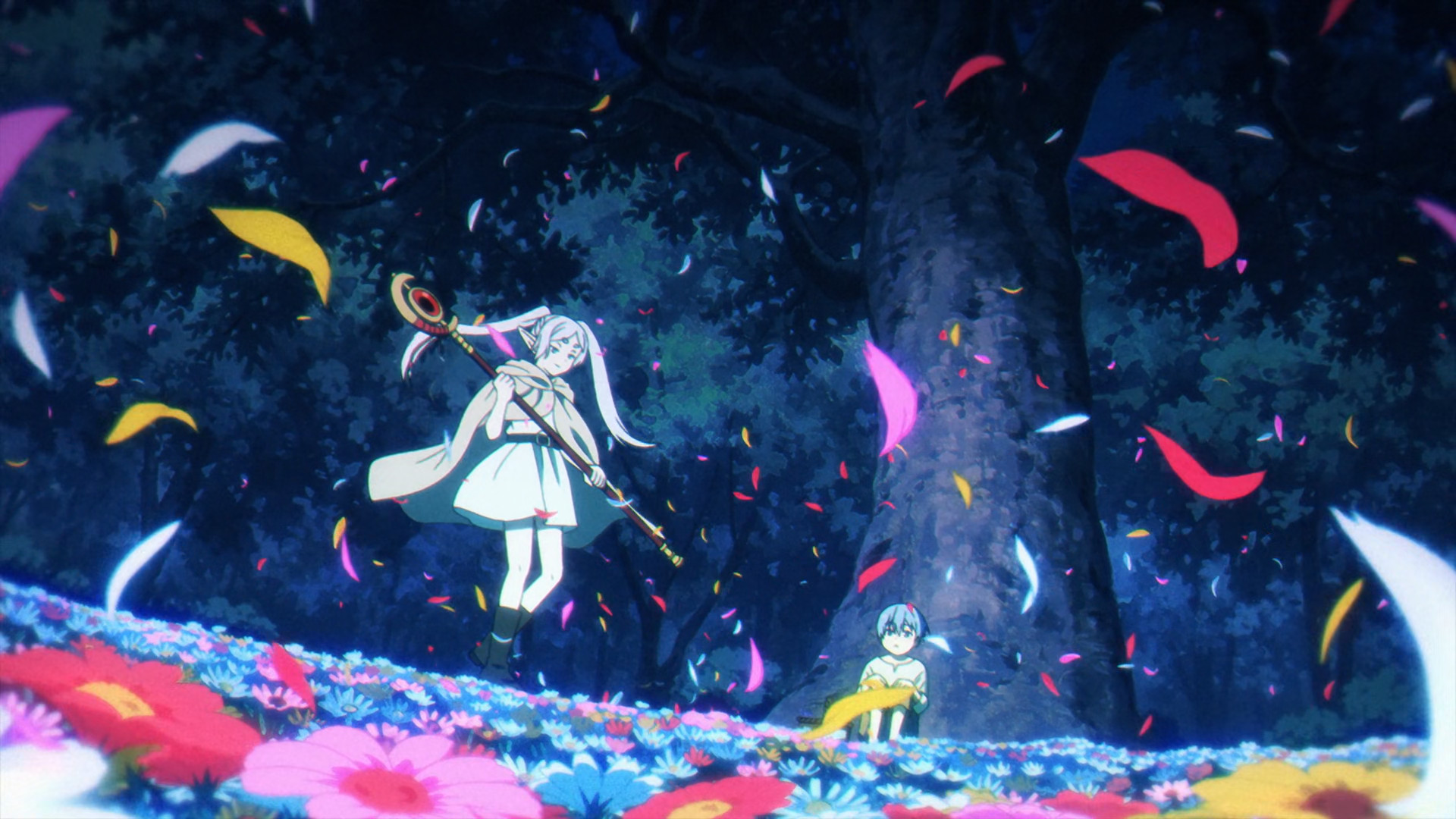
Perhaps because of human nature or just our modern view of the world, magic immediately becomes a power struggle. Questions of right and wrong are more easily decided with a conflict, and our mages begin spending most of their time training in combat. Granted, it’s been a while since I read Harry Potter, but I most remember the spells used in defense and attack, even though within the magical system, they would probably only compose a small minority. The modern anime Frieren even tries to distinguish itself in this way, where the main characters seek for increasingly mundane spells, such as making a paper airplane which travels very far, or being able to overcome any tongue twister, or the legendary spell which makes clothes clean and spotless. But even in this show (or manga), more and more space is dedicated to combat instead of the more meaningful themes, such as whether or not demons can be reasoned with, or if the humans are a mortal concern to all other creatures.
Our tendency to ruin otherwise good narratives
One may object and say that this isn’t doesn’t represent a majority of magical media, but even if it doesn’t, it more relevant question is not whether this is what the author intended, but if a desire for power is what the reader takes away from text. It doesn’t really matter if Percy Jackson is actually about identity or merely entertaining, or whatever, if kids and adults find themselves daydreaming about what they would do if they had magical powers or super strength, etc. This, which I will later adress, is what would seem to cause real harm. Unless a narrative or story immensely decreases the strength of magic, or limits it to domestic tasks the great majority of the time, people will spend more time imagining what they would get up to if they had magic, or finding themselves in a kind of awe of the more powerful characters. At the very least, this is very prevalent in children. Just think of the concept of superheroes in media. Children do not usually admire the virtue or attitude of a character, but immediately they imitate the strength or talent.
This influence makes us dissatisfied
When you stop consuming your media of choice, you quickly remember how powerless of a person that you really are: you cannot add a single year to your lifespan, or at will turn one of your hairs white or black. There are three sorts of responses to such a realization. One is simply acknowledging and moving on, trying not to let this magic affect your life, which is difficult if you see it a lot in media. Two is escapism, where you run from the world that lacks magic, and try to it into the fantasy where it’s very real. This makes people act out these fantasies, reread their favorite literature, and often buy a lot of merchandise. Option three is the most nefarious, which is where you try to bring the fantasy world into the real world, and attempt to make magical fantasy a reality. While probably nobody expects to become a Doctor Strange, we recognize that because magic would be above our level of nature, even a small amount harnessed would give us great control over our lives and surroundings.
Why three is the greatest harm
In the Christian religion, we recognize that magic, in a certain sense, actually is real. By this we don’t mean that man has some innate power source from within him, or unexercised muscle which directs the forces around us, but that there are forces which exercise control over the natural world, called the preternatural. Those with preternatural abilities would be the race of angels, which includes both good and bad, the bad being demons. Again, this is not fiction: there is not a power-scaling where demons and angels work as our familiars and can be trained like Pokemon, or have physical battles where they fire energy beams and cast shadowclonejutsu. Angels are allowed or given certain power by God, and exercise it if God allows or commands. Because it is not of our nature to suspend or go above the physical rules of the world, if we do so, it is only because an angel or God is doing so with us or on our behalf. So it follows therefore, that if humanity succeeds in a kind of magic or diviniation, they do not exercise a skill, but simply interact with a force outside of their control.
The worst case
So the fear of those against Harry Potter is that young people or obessive older fans will consume this series, and finding a dissatisfaction with the world around them, try to cast magic themselves, and if they persevere and succeed, will be in contact with an angel which they have no power over. And no, good angels do not give you powers to satisfy your boredom or curiousity, leaving demons as the only alternative.
To be clear, I don’t think that this is common. I myself am much more concerned about how media will affect me in the first two ways, since when I read a magical series I find myself lost to reality and thinking in more of the power-struggle mindset that magic implicitly exudes. Often it seems to me more desirable and more real than the world that I live in, and so becomes a massive time-suck, and one which doesn’t satisfy me much either. To me, it’s at the same level as bashing action figures together, only it’s for adults. Not that I’m above that, but rather I have to be kept from it.
What’s in it for you?
If there are these common potential defects in consuming magical media, what would make it worth it? First, and most obviously, entertainment. But there are other, more resting forms of entertainment, kinder on the eyes, and which subtly influence you in good ways (gardening?). Within literature, stories about virtue are not infinite, and it’s sometimes difficult to make them both relaxing to read, and good in content. Taking a short walk or watching birds outside is better entertainment.
A lot of magical stories are not actually that interesting anyways. Many boil down to below average “scenes” and characters, and the complex parts often become theory-internal magic, instead of a more natural political struggle or other difficulty.
Final note on anime
I don’t know exactly why this is, but modern japanese fiction has all of these problems raised up to a crazy degree. I don’t consume this content anymore, but half of what I watched/read has a power scale which is tested and measured through conflict. Easy examples are HxH, Frieren, One Punch Man, MHA, Naruto, Dragon Ball, Jujustu Kaisen, FMAB, SAO, and so on. NOTE: I AND OTHER CATHOLICS CANNOT WATCH MANY OF THESE. MANY ARE SEXUALLY EXPLICIT.
This same kind of power leveling seems to be making its way into even popular western literature, like Dungeon Crawler Carl, which is currently ascending in popularity. In many ways it already exists in many action movies, though usually not as strongly defined.
Ironically, some of this media explicitly makes fun of power scaling, or will try to work against it, but often still uses it anyways. It doesn’t matter that your favorite spell casts a field of flowers, if you spend most of your time using armor piercing offensive magic against your enemies.
So should you read/watch Harry Potter?
All things considered, I think it’s generally good to avoid magical literature in its current form. The main reasons are that much of it is vapid and there are better uses of your liesure, that it can actually make a dissonance between the real world and fiction, and the severity of someone trying to actually use magic cannot be understated. It would be cool to see magic done differently, in a way that makes the literature more interesting, and doesn’t have the effects. The Iliad and Odyssey, while both using magic in a way, have none of these side effects, and have rather interesting characters and themes running through them. It might seem extreme to avoid a large genre of entertaining media (why can’t people have a little fun?), but if Socrates and Plato want to remove the harmful music and dangerous stories of the gods from their city, then I have no problem bowing out of a relatively small part of our media matrix, the whole of which would make Plato weep and cause Socrates to start lecturing me about true beauty.